Reveal Advances Integrated Methods to Improve Census Coverage
From Framework to Action: Reveal Labs Presents Integrated Methods for Improving Census Coverage at JSM 2026
At the 2026 Joint Statistical Meetings (JSM), Reveal Labs shared research developed in collaboration with NORC at the University of Chicago on a question central to the future of federal statistics: How can organizations improve census coverage for hard-to-count populations?
The presentation, “Operationalizing the Hard-to-Count Framework: Integrated Methods for Improving Census Coverage,” described how artificial intelligence, geospatial analytics, administrative data, survey methodology, and community-informed engagement can work together to reduce coverage error and strengthen population enumeration.
As the nation prepares for the 2030 Census, improving coverage is becoming more complex. Population mobility, changing housing patterns, declining response rates, language diversity, and evolving communication preferences all affect whether people can be located, contacted, persuaded, and interviewed.
What is the Hard-to-Count Framework?
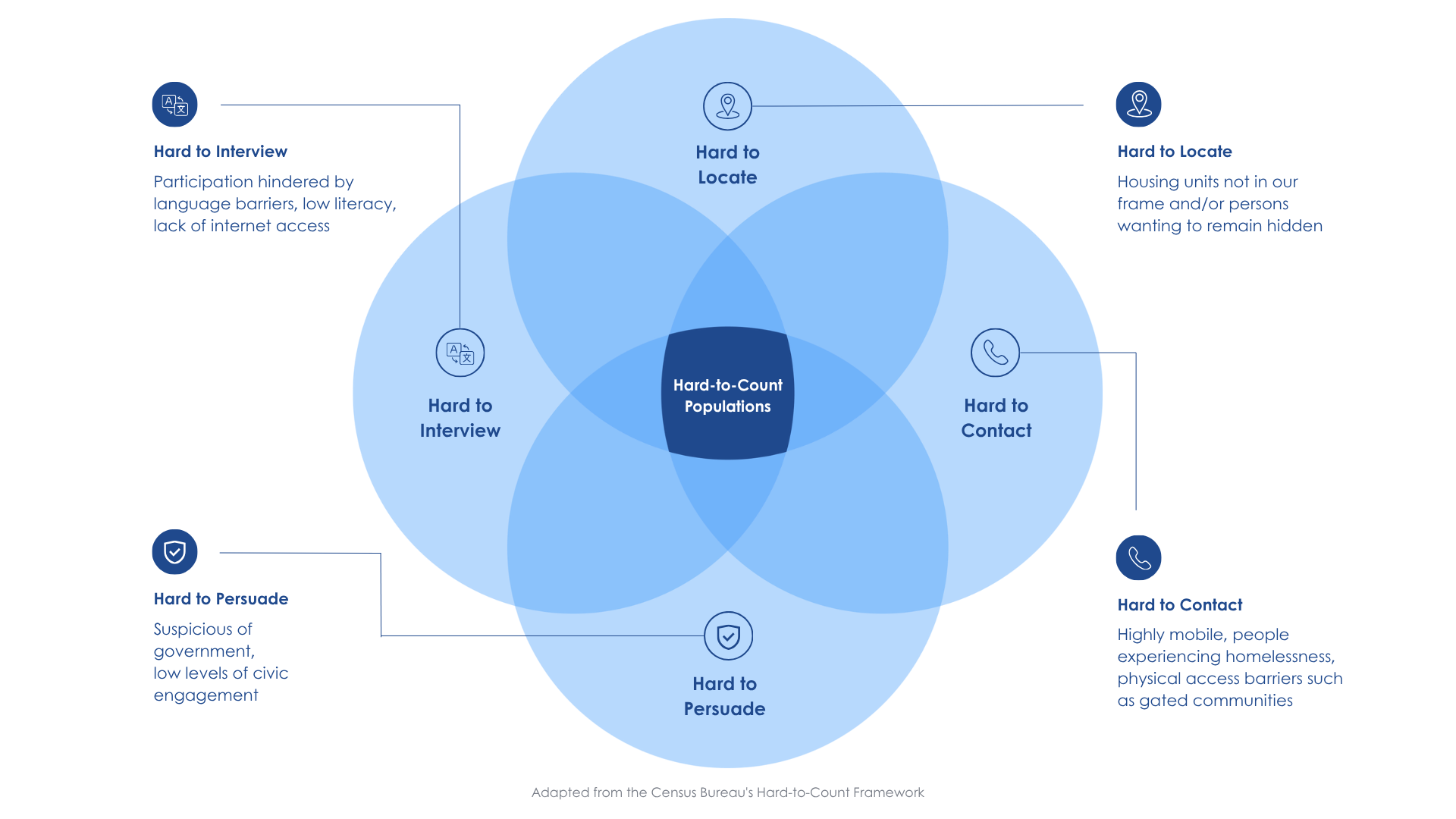
The U.S. Census Bureau’s Hard-to-Count framework explains why some people, households, or housing units may be missed. The framework focuses on four barriers: hard to locate, hard to contact, hard to persuade, and hard to interview.
How Can Census Coverage Be Improved?
Census coverage can be improved by matching the right methods to the right barriers. Reveal Labs’ research showed how integrated approaches—combining artificial intelligence, geospatial analytics, administrative data, survey design, and community-informed engagement—can strengthen every stage of enumeration.
Hard to locate: Satellite imagery, façade imagery, computer vision, and spatial analytics can help identify hidden or unconventional housing units that may be missing from traditional address frames.
Hard to contact: Administrative data integration, third-party data evaluation, and record linkage can strengthen foundational frames and help teams reach households with more accurate contact information.
Hard to persuade: Outreach testing, incentives, trusted messengers, and respondent-centered design can reduce participation barriers and improve response rates among historically undercounted groups.
Hard to interview: Multilingual support, accessible instruments, multi-mode collection, and responsible AI translation evaluation can make surveys easier to complete while protecting data quality.
Why Integrated Census Coverage Methods Matter
Integrated census coverage methods matter because better population data support better public decisions. A more complete count helps agencies, researchers, and policymakers allocate resources, evaluate programs, and plan for the future with greater confidence.
The presentation was co-authored by Taylor J. Wilson, Madeline Kelsch, and Yezzi Angi Lee of Reveal Labs, alongside Martha Stapleton and Ned English of NORC at the University of Chicago. Together, the team brought expertise across survey methodology, geospatial analytics, data science, administrative data, and community engagement to advance new approaches for improving population enumeration.
Reveal Labs is proud to contribute to the conversation on Census Bureau modernization efforts at JSM 2026 to advance practical, data-driven approaches for improving census coverage. At its core, this work supports a shared public mission: counting everyone once, only once, and in the right place.
About JSM 2026
The 2026 Joint Statistical Meetings (JSM) is one of the largest gatherings of statisticians in North America, bringing together statisticians, survey methodologists, data scientists, government researchers, and industry leaders to exchange ideas across statistical applications, methodology, analytics, and data science.